嵌入的文件
 SHENOCHI
Introduction:
In the world of snow sports, the interaction between a rider and the mountain is a dynamic dance with physics. While we celebrate the graceful arcs of a skier or the aerial acrobatics of a snowboarder, we must also acknowledge the inevitable moments when gravity wins. A fall, whether from a simple loss of balance or a miscalculated landing, is a violent event governed by the laws of motion. In the milliseconds of impact, a massive transfer of kinetic energy occurs. How that energy is managed determines the difference between a minor stumble and a season-ending injury. The evolution of protective gear is no longer just about adding bulk; it's a sophisticated application of material science and biomechanics, perfectly embodied by the technology within the 0.8in Thick 3D EVA Hip Protector Padded Shorts, which is designed to actively manipulate the physics of a fall.
The Problem: The Unforgiving Physics of an Impact
To understand the need for advanced protection, we must first understand the science of injury. When a rider falls, their body, which has mass and is moving at a certain velocity, possesses kinetic energy. According to the formula
, this energy increases exponentially with speed. When the rider hits the ground, this energy must be transferred. An impact with a hard, unyielding surface like ice or densely packed snow occurs over an extremely short period of time (Δt).
This is where the impulse-momentum theorem (
) becomes critically important. It tells us that the force (F) of an impact is inversely proportional to the duration (Δt) over which it occurs. A very short impact duration results in a massive, sharp spike of force being delivered to a concentrated area of the body. When this force exceeds the structural tolerance of bone and tissue, injury occurs. The biomechanics of the human body make the hips and coccyx (tailbone) particularly susceptible to this kind of blunt force trauma, leading to painful contusions, pelvic fractures, and coccygeal injuries that can have long-lasting consequences.
Solution: Engineering a Slower Collision with Advanced Polymer Science
The 0.8in Thick 3D EVA Hip Protector Padded Shorts are engineered to fundamentally alter the physics of an impact. The solution lies in the material science of its core component: the 20mm (0.8in) thick, closed-cell Ethylene-vinyl acetate (EVA) foam.
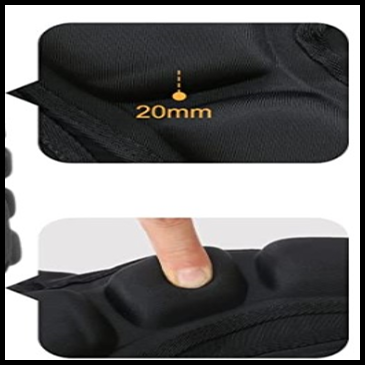
As the first new image clearly illustrates, the 20mm thickness of the padding is a critical engineering specification. This thickness provides the essential space and time required to cushion a fall. It physically increases the duration of the impact (Δt). By decelerating the body over a longer period, it drastically reduces the peak force (F) that is ultimately transferred to the rider, in direct accordance with the impulse-momentum theorem.
The second image, showing a finger compressing the foam, visualizes the material’s primary function: high-efficiency energy conversion. EVA foam is a thermoplastic copolymer with a unique closed-cell structure. Each cell is like a tiny, sealed balloon. Upon impact, these cells compress, and the gas trapped within pushes back, creating a progressive resistance. This process is incredibly effective at converting the dangerous, focused kinetic energy of the fall into a negligible amount of heat and elastic potential energy stored within the foam's structure. As the foam rebounds to its original shape, this stored energy is released harmlessly. This entire process transforms a violent, sharp impact into a much softer, more manageable event, keeping the forces below the threshold of injury. The "Stretchy & Sturdy" Lycra and Spandex chassis acts as the perfect delivery system, holding this advanced foam precisely over the body's most vulnerable biomechanical points.
Key Benefits from a Biomechanical Perspective:
Optimized Force Dissipation: The primary function of the EVA foam is to dissipate and redistribute the focused force of an impact over a larger surface area and a longer time frame, preventing it from overwhelming any single point on the body.
High-Efficiency Kinetic Energy Conversion: The shorts act as a mechanical transducer, converting the kinetic energy of the rider's fall into other, less harmful forms of energy, primarily through the controlled compression and rebound of the EVA polymer structure.
Engineered Impact Duration: The specified 20mm foam thickness is a deliberate design choice to lengthen the deceleration period of a fall, directly mitigating the peak force experienced by the athlete according to the fundamental laws of physics.
Material Resilience for Repeated Impacts: EVA foam is a "Sturdy" material known for its excellent memory and resistance to "packing out" (permanent compression). This ensures it can withstand numerous impact cycles throughout a season without degrading its protective qualities.
Anatomical and Biomechanical Integration: The 3D molded pads and "Skin-Friendly" flexible chassis are "Designed for Sports Protection" to move with the body's natural articulation. This ensures the protection remains correctly positioned and does not interfere with the biomechanics of skiing or snowboarding.
Conclusion:
The 0.8in Thick 3D EVA Hip Protector Padded Shorts are a testament to how far protective gear has come. They are far more than simple padding; they are a wearable piece of sophisticated engineering that applies principles of physics, material science, and biomechanics to provide a tangible safety advantage. By actively manipulating the variables of force, time, and energy during a fall, this gear provides a crucial layer of scientifically validated protection. This allows athletes, from beginners to professionals, to push their limits with greater confidence, knowing they are not just wearing foam, but a scientifically designed system for managing the unforgiving physics of the mountain.


Location
NO 152, Zenglu Road, Chashan Town Dongguan City, China

Email
shenochisport@gmail.com

Phone
Carrie +86 18944754602
Nickle +86 18948618470
Gaga +86 18944763147