嵌入的文件
 SHENOCHI
Introduction:
The discipline of backcountry skiing and splitboarding is a tale of two vastly different physiological challenges: the long, arduous, and heat-generating ascent, followed by the cold, fast, and high-risk descent. For the modern backcountry athlete, the greatest challenge in apparel design is finding a single system that can excel in both of these opposing environments. The key to solving this puzzle lies in a sophisticated engineering principle known as "body mapping" or "zoned construction"—an approach that moves beyond single-fabric designs to create a garment that is intelligently adapted to the specific needs of different parts of the body. This science is perfectly illustrated in the construction of advanced gear like the P-SN-016 Protective Padded Shorts.
The Problem: The Inefficiency of Uniform Design for a Zone-Specific Challenge
During the strenuous, multi-hour aerobic activity of a backcountry ascent, the human body does not produce heat and sweat uniformly. Physiological studies and thermal imaging show that certain areas are "hot zones" which perspire at a much higher rate. These include the lumbar region (lower back), the chest, and the groin/hip flexor area.
A garment constructed from a single, uniform fabric presents an inefficient, one-size-fits-all solution to this complex, zone-specific problem. A fabric that is durable and abrasion-resistant enough for the high-wear seat and outer thigh areas is often not breathable enough for the high-sweat lower back. Conversely, a fabric that is open-weave and breathable enough for the groin might not be sturdy enough to provide the structural integrity needed for the rest of the garment. This leads to a compromised system where hot zones overheat and become saturated with sweat. This trapped moisture is a primary cause of discomfort and chafing on the ascent, and it poses a significant risk of conductive hypothermia when the athlete stops climbing and is exposed to the cold wind at the summit.
Solution: A Body-Mapped System for Physiological Efficiency
The P-SN-016 Protective Padded Shorts employ the principle of body mapping to create a more intelligent and efficient thermoregulatory system. This design philosophy involves strategically placing different materials in different areas of the garment to optimize its function based on a "map" of the body's physiological output.
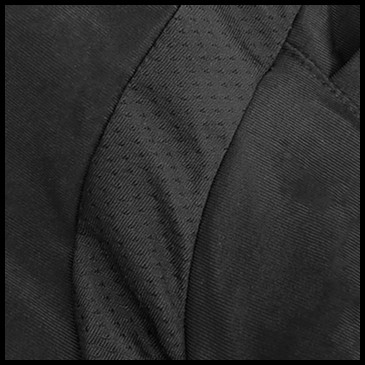
As the close-up image, showing a highly porous mesh fabric integrated along a seam line, clearly demonstrates, this is a product of zoned construction. This is not simply a style choice; it is a calculated engineering decision. Designers have identified the hip flexor and groin area as a critical heat and moisture zone. In response, they have strategically placed a highly air-permeable, open-weave mesh fabric in this precise location. This panel acts as a dedicated ventilation port.
This system works in two ways:
Enhanced Breathability: The open structure of the mesh allows metabolic heat and water vapor to escape from the skin's surface at a much higher rate than a standard knit fabric.
A Moisture Vapor Superhighway: The main "Breathable and Moisture wicking Fabric"—the 80% Polyester / 20% Spandex blend—excels at pulling liquid sweat away from the skin. When this wicked moisture reaches the mesh zones, it has a "superhighway" to be transported out of the apparel system and evaporate, preventing the fabric from becoming saturated.
This intelligent design directly contributes to an athlete's endurance. The human body is an engine, and it performs most efficiently when properly cooled. By creating a more effective thermoregulatory system, the body-mapped design reduces the amount of metabolic energy the athlete must expend to cool themselves down. This saved energy translates directly into greater physical endurance for the long climb. This entire advanced comfort system is built around a core of "All-round Protection," with "Shock Proof" EVA pads providing the essential safety for the unpredictable descent.
Key Benefits for the Backcountry Athlete:
Optimized Thermoregulation and Climate Control: The body-mapped placement of highly breathable mesh in critical high-heat zones leads to superior overall climate control during strenuous uphill efforts.
Enhanced Metabolic Efficiency and Endurance: By aiding the body's natural cooling processes more effectively, the garment helps the athlete conserve precious energy, leading to reduced fatigue and the ability to travel further.
Increased Comfort and Reduced Chafing: By strategically managing heat and moisture in the areas most prone to sweating, the design drastically reduces the risk of the fabric saturation and friction that lead to painful skin irritation.
No-Compromise Durability and Protection: The system intelligently uses durable, supportive fabrics where needed (e.g., the main chassis) and breathable fabrics elsewhere, all while providing the comprehensive impact safety of the "Shock Proof" EVA pads for the descent.
A Lighter, More Intelligent System: Body mapping allows for the most efficient use of materials, creating a smarter, often lighter overall garment that is perfectly tuned to the physiological demands of the sport.
Conclusion:
The future of technical mountain apparel lies in designs that are not just protective or warm, but are intelligently adapted to the complex physiological needs of the athlete in motion. The P-SN-016 Protective Padded Shorts, with their sophisticated body-mapped construction, are a clear embodiment of this forward-thinking principle. By strategically engineering zones of extreme breathability into a durable and highly protective chassis, this gear provides an elegant solution to the intense thermoregulatory demands of the backcountry ascent. It is a system that keeps the athlete cooler, drier, and more efficient, empowering them to climb higher, explore further, and descend with the utmost confidence.

Location
NO 152, Zenglu Road, Chashan Town Dongguan City, China

Email
shenochisport@gmail.com

Phone
Carrie +86 18944754602
Nickle +86 18948618470
Gaga +86 18944763147