嵌入的文件
 SHENOCHI
Introduction
The world of snow sports, particularly snowboarding, offers an intoxicating blend of freedom, adrenaline, and creative expression. The feeling of effortlessly gliding over snow, "surfing" down a mountain, is a sensation that draws millions of new participants each year. However, this rewarding sport has a notoriously steep and painful barrier to entry, especially for beginners. Unlike skiing, where the primary learning injuries often involve the knees, snowboarding’s initiation phase is defined by a different, and far more common, threat: the wrist injury. In fact, wrist fractures are statistically the single most common injury in snowboarding, accounting for a massive percentage of all emergency room visits. This is not due to a flaw in the sport, but a flaw in human reflexes. The problem is a biomechanical event known as a "FOOSH" (Fall On an Outstretched Hand), and it can only be solved with a specific, rigid solution.
The Problem: The Inevitable Fall and the FOOSH Reflex
For anyone who has ever learned to snowboard, the memory is a painful one. The first few days are a humbling cycle of catching an edge, slamming onto the hard-packed snow, getting up, and repeating the process. The most common fall for a beginner is catching the "heel-side" edge, which results in a high-impact, backward fall.
In this split-second moment, human instinct takes over. To protect the head and spine from impact, the brain sends an immediate signal to the arms: "break the fall." The rider instinctively throws their hands out behind them, palms down, to catch their own body weight. This is the "Fall On an Outstretched Hand," or FOOSH. While this reflex successfully protects the head, it transfers the entire kinetic energy of the falling rider—all their body mass plus the speed of the fall—onto one of the smallest and most complex joints in the body: the wrist.
The physics of this event are brutal. The wrist is not designed to absorb this type of load. As the palm hits the unyielding snow, the joint is forced into extreme hyperextension (bending backward far beyond its normal range of motion). This pressure causes the small carpal bones to compress and the long bones of the forearm (the radius and ulna) to shear against them. The result is almost inevitable: a distal radius fracture, a scaphoid fracture, or a severe sprain. This is a season-ending, painful, and expensive injury.
The "problem" is therefore twofold:
The Biomechanical Certainty: The FOOSH reflex is an unavoidable, hard-wired human instinct.
The Failure of Soft Padding: Many beginners, if they wear any protection at all, opt for soft foam pads or gloves with some padding. These solutions do nothing to address the root cause of the injury. A foam pad may slightly dampen the "slap" of the impact, but it provides zero structural resistance to hyperextension. The wrist will still bend back, and the bone will still break.
Solution: The D-SN-001 Aluminum Wrist Guard System
To solve a structural problem, you need a structural solution. This is the design principle behind the Aluminum Wrist Guard (No: D-SN-001). This device is not a "pad"; it is an engineered brace designed specifically to neutralize the dangerous physics of a FOOSH.
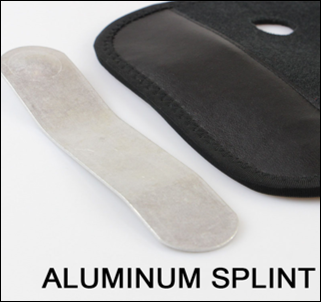
The core of this system is its Inner Pad: ALUMINUM SPLINT. As the provided image of the splint shows, this is a rigid, pre-curved piece of high-strength, lightweight aluminum. This splint is the "hero" of the design and is housed within a durable, comfortable sleeve.
Here is how the solution works in practice: The wrist guard is worn on the hand, with the rigid aluminum splint positioned along the palmar (palm) side of the wrist. When the snowboarder falls backward and instinctively puts their hand out, the ALUMINUM SPLINT makes contact with the snow first. Because it is rigid, it cannot bend. It acts as a lever or a "stop," physically preventing the wrist from achieving the angle of hyperextension required to cause a fracture.
Instead of the force concentrating on the small wrist bones, the splint distributes the entire impact load up the forearm, engaging the two large, strong bones of the arm (the radius and ulna). The forearm is more than capable of handling this compressive force, and the delicate wrist joint is completely bypassed. The impact is absorbed by the body's stronger structures, and the injury is averted.
This core function is supported by several critical design features:
Thumb Hole Design: This is essential for stability. The thumb loop anchors the guard, ensuring that the aluminum splint stays perfectly aligned with the palm and wrist. It prevents the guard from slipping or twisting, which is a common failure point in poorly designed protectors.Adjustable Velcro: A secure fit is mandatory. The adjustable straps lock the entire system in place, allowing the user to customize the compression and ensure the guard is firmly secured. This guarantees that the splint will be in the correct position when the fall occurs.Fabric: 80% Polyester + 20% Spandex: This performance fabric makes the guard a low-profile, "second skin." It is stretchy, breathable, and comfortable, allowing it to be worn easily under a snowboard glove or mitten without restricting blood flow or movement.
Key Benefits for Snowboarders, Skiers, and Skaters
This intelligent, structural design delivers a host of benefits that go far beyond simple impact resistance.
1. Direct Prevention of Hyperextension FracturesThis is the primary and most critical benefit. This guard provides true Impact Resistant properties by neutralizing the mechanism of the injury. It is not just cushioning a blow; it is a biomechanical intervention that stops the joint from breaking. This is the only proven method to prevent the FOOSH-related wrist fractures that plague beginner snowboarders.
2. Accelerated Skill Progression and ConfidenceThe Aluminum Wrist Guard is, in effect, a learning tool. By removing the debilitating pain and fear associated with falling, it breaks the "Fear-Tension-Fall" cycle. A beginner who is not terrified of breaking their wrist is a beginner who can relax. This relaxed, athletic stance is the key to linking turns and progressing. This guard gives new riders the confidence to commit to their edges, allowing them to learn in days what might otherwise take weeks of painful trial and error.
3. Low-Profile, Ergonomic IntegrationUnlike bulky, "Robocop" style plastic guards, this system is sleek. The 80% Polyester + 20% Spandex fabric and Thumb Hole Design create a comfortable, ergonomic fit. It does not interfere with the fine motor skills needed to adjust bindings, zip up a jacket, or hold a ski pole (as this product is also suitable for Ski, especially for beginners).
4. Versatile, Multi-Season UtilityAs the product description explicitly states, this guard is Perfect for snowboard, Ski, Skateboard, skate, etc. The physics of a FOOSH are identical whether you are falling on hard-packed snow or concrete. This makes the D-SN-001 an invaluable piece of protective gear for multiple sports. A snowboarder in the winter becomes a skateboarder in the summer, and this single piece of equipment provides the same essential, bone-saving protection in all of these high-risk activities.
Conclusion
The Aluminum Wrist Guard (D-SN-001) is a critical piece of safety equipment, arguably the most important one a beginner snowboarder can buy. It is a product of intelligent, purposeful design, created to solve a specific and well-understood biomechanical problem. While soft pads can only offer a small degree of comfort, the rigid ALUMINUM SPLINT at the core of this guard offers true prevention. By stopping hyperextension and redirecting impact forces, this guard provides the physical protection and psychological confidence needed to overcome the sport's greatest barrier, paving the way for a long and injury-free passion for the mountain.

Location
NO 152, Zenglu Road, Chashan Town Dongguan City, China

Email
shenochisport@gmail.com

Phone
Carrie +86 18944754602
Nickle +86 18948618470
Gaga +86 18944763147