嵌入的文件
 SHENOCHI
Introduction
In the "Football & Rugby series," the human body is both a weapon and a target. While helmets and shoulder pads protect the upper torso, the lower body—the athlete's "engine" and "suspension"—is often exposed to a relentless barrage of impacts. Specifically, the quadriceps muscles and the patellar (knee) region are two of the most frequently traumatized areas. A direct, high-velocity impact from a helmet or shoulder to the thigh can cause a debilitating "quadriceps contusion," while the repeated, brutal contact of the knees with the ground or other players is a constant for linemen and forwards. The traditional "solution" involved inserting stiff, pre-molded pads into pockets, a system that was bulky, restrictive, and prone to "pad slip." This antiquated approach has been rendered obsolete by modern performance apparel, which utilizes integrated, articulated padding systems designed to protect these specific zones without compromising the athlete's mechanics.
The Problem: The High Cost of "Dead Legs" and Patellar Impacts
The failure of traditional equipment stemmed from its inability to solve three distinct problems that plague football and rugby players, as seen from the perspective of thigh and knee protection.
The "Dead Leg" (Acute Quadriceps Contusion): The quadriceps is the massive muscle group at the front of the thigh, responsible for explosive power in sprinting and jumping. In a tackle, this area is a primary target. A direct blow compresses the muscle against the femur (thigh bone), causing deep tissue hemorrhage and intense pain. This injury, commonly called a "dead leg," is not a minor bruise. It can instantly rob a player of their explosive power, and severe or repeated cases can lead to Myositis Ossificans, a serious condition where bone tissue begins to form inside the muscle, requiring surgical intervention. Old pads offered poor protection, as they were often too soft, too hard, or simply shifted out of place, leaving the quad exposed.
Patellar Vulnerability in Ground Play: For football linemen in a three-point stance or rugby forwards in a ruck, the knees are a point of constant, direct contact. This includes high-force impacts from helmets during low tackles and the abrasive, repetitive shock of hitting the ground, especially on unforgiving artificial turf. A direct blow to the patella (kneecap) is excruciating and can lead to bone bruises that linger for an entire season.
Compromised Running Gait: The most significant performance failure of old padding was its stiffness. Traditional thigh pads were often single, large, inflexible pieces of foam. This "splint-like" effect actively restricted the athlete's running gait. It shortened their stride, limited knee-lift, and created resistance during the leg's recovery phase, effectively making the athlete slower and forcing them to expend more energy to fight their own equipment.
Solution: An Integrated System of Articulated, Anchored Padding
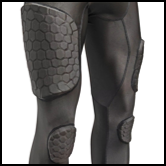
The modern Padded Compression Pant (P-FB-013), as seen in the close-up image of its thigh and knee pads, is a sophisticated solution that addresses all three problems through intelligent material science and design.
1. The Articulated EVA Pad (The Shield):The most visible innovation, shown clearly in the new image, is the hexagonal, "hex-padded" design. This is the physical manifestation of the Lightweight and Flexible specification. The Inner Pad: EVA Pad is not one solid, stiff block. It is a matrix of smaller, interconnected pods. This "articulation" is the key. It allows the large thigh pad to bend, flex, and wrap around the quadriceps muscle, moving with the athlete as the muscle contracts. Similarly, the knee pad flexes fluidly with the joint's flexion and extension.
This EVA Pad material is the shock absorber. When a helmet strikes the thigh, this articulated matrix dissipates the force laterally across the entire pad, preventing the "pin-point" pressure from crushing the muscle tissue beneath.
2. The Anatomical Mapping (The 7 PCs Professional EVA Pads):The "7 PCs" designation is not a random number; it refers to a professional, anatomically-mapped system. As the image shows, the thigh pad is a large, custom-shaped shield designed to cover the entire quadriceps. The knee pad is a distinct, smaller component shaped specifically to cover the patella. This is a crucial distinction from "one-size-fits-all" pads. The protection is placed exactly where the injuries occur, with a design tailored to that body part's function.
3. The Compression Chassis (The Anchor):This entire system is rendered useless if it doesn't stay in place. This is the critical function of the Fabric: 80% Polyester + 20% Spandex. The high percentage of Spandex provides the powerful, four-way stretch compression that "locks" the garment to the athlete's body. This compression fit is the anchor. It ensures that the knee pad always stays centered on the patella and the thigh pad always remains over the quadriceps, completely eliminating the "pad slip" that plagued traditional gear.
This chassis is supported by its Moisture wicking and Quick dry properties. The polyester actively pulls sweat away from the skin, keeping the garment light and preventing it from sagging. A dry, light garment maintains its compressive integrity, ensuring the pads stay locked in their professional positions from the first play to the last.
Key Benefits for High-Impact Athletes
This fusion of an articulated pad with a compression chassis delivers profound, measurable benefits on the field.
Proactive Prevention of Muscle Contusions: The primary benefit is the superior protection against "dead legs." The shock-dissipating
EVA Padmatrix absorbs and distributes the acute impact of helmets and shoulders, shielding the muscle from deep-tissue trauma and reducing the risk of Myositis Ossificans.Unlocked Biomechanics and Speed: By replacing stiff, board-like pads with a
Lightweight and Flexiblearticulated system, the athlete's natural running gait is restored. There is no resistance, no "splinting" effect. This directly translates to a longer stride, faster leg recovery, and higher top-end speed.Total Patellar Security for Ground-Contact Players: Linemen, linebackers, and rugby forwards gain a new level of confidence. The anchored, flexible knee pad provides reliable, targeted protection from impacts and abrasions, whether they are driving off the line or battling in a ruck.
Season-Long Durability: This system is not just about preventing one big injury; it's about mitigating the thousands of "micro-impacts" that accumulate over a season. By consistently protecting the quads and knees, the gear reduces the cumulative "wear and tear" that breaks athletes down by mid-season.
Conclusion
The Padded Compression Pant represents a monumental shift from simple padding to a true performance system. As evidenced by its advanced, articulated hex-pad design, the focus is no longer just on protection, but on protection without compromise. For the "Football & Rugby series" athlete, whose success is defined by explosive power, this technology is essential. By integrating a Lightweight and Flexible EVA Pad system directly into a Quick dry, compressive Polyester/Spandex chassis, it solves the critical vulnerabilities of the quadriceps and knees, all while enhancing—rather than restricting—the athlete's speed and mobility.

Location
NO 152, Zenglu Road, Chashan Town Dongguan City, China

Email
shenochisport@gmail.com

Phone
Carrie +86 18944754602
Nickle +86 18948618470
Gaga +86 18944763147