嵌入的文件
 SHENOCHI
Introduction
In the world of the Football&Rugby series, the quest for athletic development has created a new, hyper-fast, and incredibly popular sub-field: 7on7 football. This "non-contact," pass-focused format has exploded in popularity, becoming the premier off-season training ground for skill-position players (Quarterbacks, Receivers, Defensive Backs) from the youth level to elite college recruits. The game is designed to isolate and amplify speed, agility, and "skill-on-skill" competition by removing the "brute force" elements of blocking and tackling. However, this "non-contact" label is a dangerous misnomer. In a game where elite, high-speed athletes are all converging on a single ball, high-velocity incidental collisions are not just a risk; they are an absolute certainty. This reality has created a critical equipment gap, leaving players caught between the danger of no protection and the cumbersome, inappropriate design of "full-contact" gear.
The Problem: The "Safety vs. Speed" Dilemma
The "7on7" format presents a unique set of physical challenges that traditional football equipment was never designed to solve. The "problem" is twofold, representing two bad choices for a high-performance athlete.
1. The "Non-Contact" False Sense of Security:The single greatest problem in the 7on7 world is the cultural belief that "non-contact" means "no-risk." Because tackling is banned, the vast majority of players compete wearing no head protection at all—often just a soft headband or hat. This creates a massive, unaddressed vulnerability. When two 180-pound athletes, both running at full speed (4.5-second 40-yard dash times), leap to catch the same pass, the resulting head-to-head, head-to-knee, or head-to-shoulder collision carries enormous kinetic force. This "incidental" contact can easily result in deep lacerations (cuts), contusions (bruises), and, most dangerously, concussions. Furthermore, when a player is "up-ended" during such a collision, the resulting whiplash impact with the hard artificial turf can be just as traumatic. The "non-contact" label has created a "safety gap," where players are exposed to significant risk with zero protection.
2. The "Hard-Shell" Performance Penalty:The "obvious" solution—mandating full-size, hard-shell tackle helmets—is an equally poor choice. A hard-shell helmet is a piece of heavy, hot, and cumbersome armor. It is a brilliant piece of engineering for its purpose: to stop a 300-pound lineman's block or a full-speed, "head-on" tackle. But none of these events exist in 7on7. For a skill-position athlete, this hard-shell helmet is a "performance-killer."
It's Hot: It traps heat, causing players to overheat, which degrades performance and focus.
It's Heavy: The weight slows the athlete down, compromising the "speed" and "agility" that the 7on7 format is designed to showcase.
It's Restrictive: It limits peripheral vision and, critically, blocks sound, making it harder for quarterbacks and defensive leaders to communicate—a key element of the game.
Athletes are thus forced to choose: either compete at 100% of their speed and agility while being completely unprotected, or be protected from an event (tackling) that won't happen, while sacrificing the very speed and performance that define their game.
Solution: The H-FB-001, A Purpose-Built, Performance-First Safety System
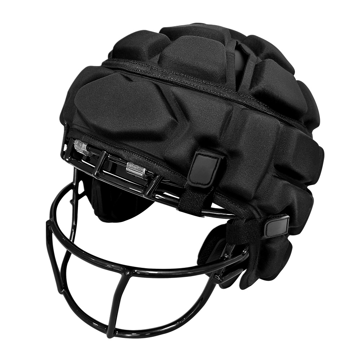
This critical "safety vs. speed" gap is precisely where the 7on7 Soft Shell Helmet (No: H-FB-001) provides the perfect, purpose-built solution. It is not a "tackle" helmet, nor is it a simple headband. It is an engineered piece of performance-safety equipment that provides protection only where it's needed, without any of the performance penalties of a hard-shell.
The system is a fusion of advanced, lightweight materials:
The Protective Engine (
Inner Pad: EVA foam): The core of the helmet is a strategically-mapped system of Anti-collisionEVA foampads. This is the same high-tech, energy-absorbing foam used in a variety of high-impact sports. This foam is not designed to stop a full-speed tackle. It is designed to perfection to absorb and dissipate the specific forces of "incidental" 7on7 collisions—the head-to-head clash, the stray knee, or the hard impact with the turf. It provides a massive layer of protection against cuts, contusions, and the jarring forces that can lead to concussions.The Performance Chassis (
Fabric: 80% Polyester + 20% Spandex): TheEVA foamis integrated into a chassis made of a high-performance athletic blend. ThisFabricis the key to solving the "hard-shell" problem. It is incredibly Breathable and Moisture wicking, actively pulling sweat away from the head and allowing heat to escape. This keeps the athlete cool, dry, and focused, even in the heat of a summer tournament.The Custom Fit (
AdjustableLacing): As the product image shows, the helmet features a "scrum cap" style lacing system in the back. This is theAdjustablecomponent. It allows each athlete, from SizeStoXL, to dial in a perfect, "locked-in" 360-degree fit. This is critical: a helmet that wobbles is a helmet that fails. This system ensures theEVA foamis always snug and in the correct position to take an impact.
Key Benefits for the 7on7 Athlete and Program
By adopting this purpose-built solution, 7on7 athletes and programs gain a spectrum of benefits that neither "no helmet" nor "hard-shell" can offer.
1. "Right-Sized" Anti-collision ProtectionThe primary benefit is safety without compromise. The EVA foam system provides true, meaningful Anti-collision protection against the actual risks of the 7on7 game. It shatters the "false sense of security," allowing players to compete aggressively with the confidence that an accidental clash or a bad fall is far less likely to result in a serious head injury.
2. Elite Thermal Regulation and PerformanceThis is the benefit that athletes feel on every play. The lightweight, Breathable, and Moisture wicking Fabric chassis is a "performance-multiplier." It eliminates the "greenhouse effect" of hard-shells. Athletes stay cool, their stamina is preserved, and their focus remains high. They are not weighed down or overheated, allowing them to perform at their peak.
3. Uncompromised Speed and Situational AwarenessThe H-FB-001 is designed for skill players. Its "soft-shell" design and open-ear construction do not muffle sound or block peripheral vision. A quarterback can still hear defensive checks. A safety can still "hear" the footsteps of a receiver entering their zone and use their full field of vision to track the ball. It protects the head without isolating the athlete from the game.
4. A Secure, "Locked-In" Customizable FitThe Adjustable lacing system is the key to both comfort and safety. It allows for a truly customized fit that molds to the individual's head shape. This "locked-in" feel, combined with the stretchy 80% Polyester + 20% Spandex fabric, means the helmet never shifts, wobbles, or slides during a full-speed sprint, cut, or jump. It becomes a seamless part of the athlete.
Conclusion
The 7on7 Soft Shell Helmet (H-FB-001) is a critical piece of modern, specialized sports equipment. It is the definitive answer to the "safety vs. speed" dilemma that has plagued the fastest-growing segment of football. By rejecting the "one-size-fits-all" approach of old-school gear, it provides a perfectly "right-sized" solution. It fuses Anti-collision EVA foam for essential protection with a Breathable, Moisture wicking fabric chassis for elite performance. For the high-skill, high-speed 7on7 athlete, this is not just a helmet; it is the gear that finally allows them to be both 100% fast and 100% protected.

Location
NO 152, Zenglu Road, Chashan Town Dongguan City, China

Email
shenochisport@gmail.com

Phone
Carrie +86 18944754602
Nickle +86 18948618470
Gaga +86 18944763147