
The right padded football shorts are the pair whose coverage, fit, construction and documentation match the intended kit and purchasing brief. Product names alone are not enough: pad zones, garment measurements, layering and available evidence can vary by style. Before comparing suppliers, write down what the shorts must cover, how they will be worn and what your team or brand needs to verify.
This guide is for teams, distributors and sportswear brands evaluating a product or preparing a wholesale or custom-order request. It focuses on the questions that make a sample and quotation easier to assess. It does not assign a protection rating to a garment or replace the rules and equipment guidance that apply to a specific competition.
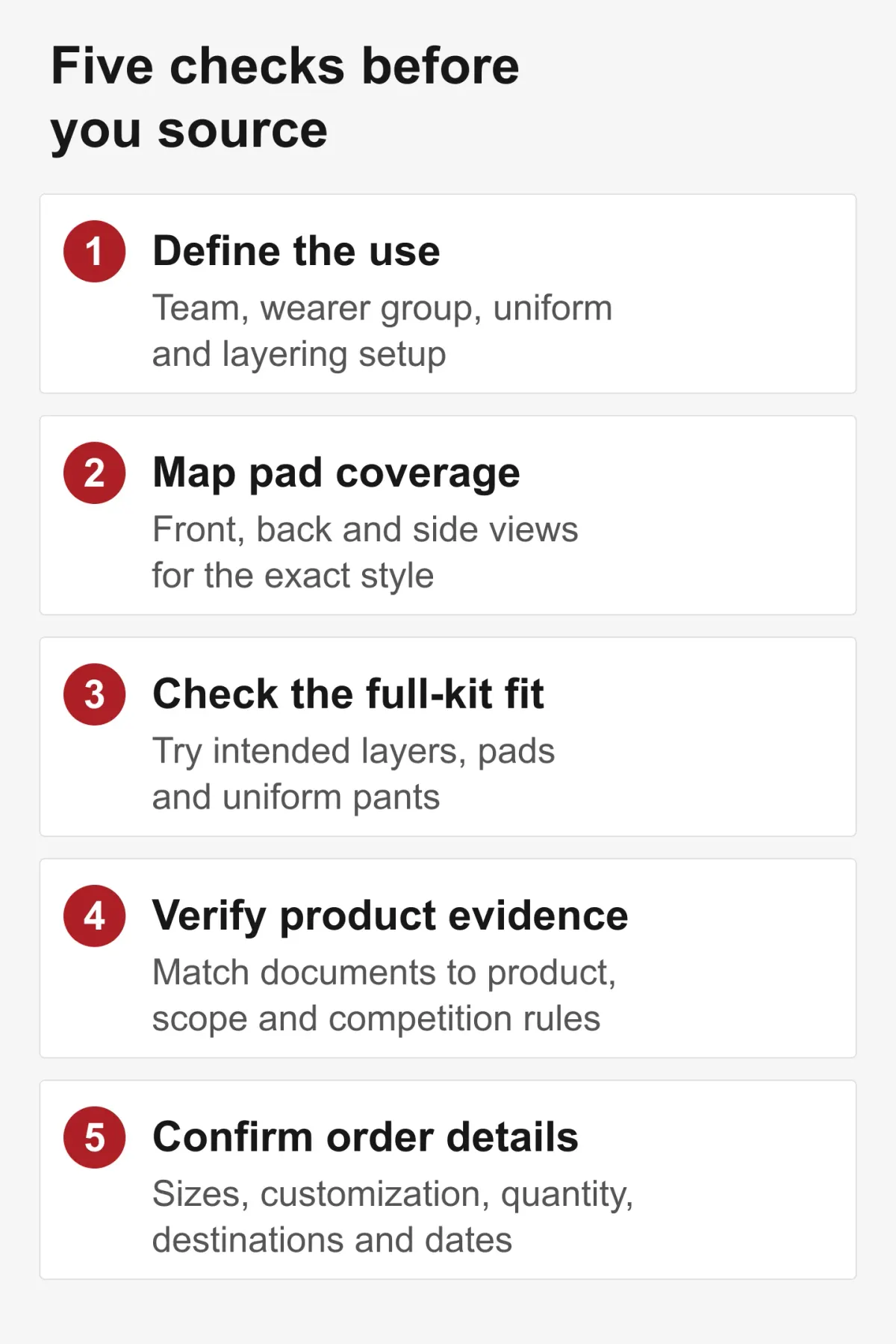
1. Define the use and layering setup
Start with the kit the shorts must work with. Record the intended wearer group, training or game context, uniform pants, and any base layer or girdle the team expects to use. Ask whether the padded short is meant to be worn directly against the skin, over another garment, or as part of a particular uniform system. Do not assume that two products called “padded shorts” use the same layering arrangement.
If the equipment is for a league, school or club, identify its current rules and any required approval or documentation before choosing a design. Ask the relevant organization to clarify its requirements. A supplier’s general experience or a material description does not establish that a particular product is approved for a particular competition.
2. Map the coverage instead of relying on the product name
Ask the supplier for a clear front, back and side view that shows every pad zone. Compare that map with the body areas your team wants covered and with the space available inside its uniform pants. Confirm whether the pads are integrated into the garment or supplied in a separate layer, and ask how they are attached and positioned during wear.
For a custom project, turn the intended layout into a written reference: marked-up artwork, a sample, or a specification drawing. Identify any required pad dimensions, thickness, shape, material and tolerance. Those details should be confirmed for the selected style and size; do not infer them from a product photo or from another model.
3. Check fit with the complete kit
Use the supplier’s current size chart as the starting point, then evaluate a sample in the intended size range. A size label by itself does not show how a garment fits across different body measurements or production versions.
Have the wearer try the shorts with the same layers, girdle, football pants and pads used in the intended setup. Check that the garment can be put on as planned, the pad zones stay where intended, the waistband and leg openings feel acceptable, and the fabric does not bunch or restrict the movements required by the team. Set the team’s acceptance criteria before approving a production sample.
For a team order, record the size mix and how sizing was checked. If the style, fabric, pad layout or size grading changes, ask whether a new sample or fit review is needed.
4. Compare fabric and construction against the brief
Ask for the fiber composition and the construction details that matter to your program. Depending on the design, these may include stretch and recovery, moisture-management requirements, seam placement, reinforcement, pad-pocket construction and attachment. Treat these as specification questions: the performance of one fabric or garment cannot be assumed for every padded short.
If you require claims such as moisture-wicking, abrasion resistance, pad retention or a quantified impact result, ask what test method, conditions, product version and result support each claim. Request the relevant report or technical document and check that it applies to the exact design being quoted. Do not treat a general capability statement as a product test result.
Care instructions matter too. Ask for the finished garment’s care label and confirm that the washing method is compatible with its fabric, seams and pad construction. Use the care instructions for the exact product version.
5. Verify qualifications and project experience
If a procurement brief requires a certification, test report, factory qualification or prior project reference, specify exactly what is needed. Review the document name, issuer, validity period, scope and the product, facility or process it covers. A qualification is useful only when its scope matches the requirement being evaluated.
SHENOCHI began manufacturing in 2009 and has 17 years of factory experience as of 2026. Relevant qualifications and sports-protection project references are available for buyer review. For a padded-shorts inquiry, request the documents and project references that apply to the selected product and your intended market; do not assume that every qualification covers every product.
6. Prepare a complete wholesale or custom-order brief
Before requesting a quotation, send the supplier a concise brief. Include:
- Intended use, wearer group and competition or organization requirements.
- Pad-zone map and any required dimensions, materials or construction details.
- Current sample or reference garment, if available, with the features to retain or change.
- Size range, measurement chart, grading expectations and estimated size mix.
- Fabric and color preferences, branding, labels and packaging requirements.
- Requested tests, certificates or other documents, including the required scope.
- Target quantity, sample destination, delivery destination and requested dates.
- Sample approval steps and the criteria your team will use to accept the fit and construction.
Ask the supplier to confirm which items are available for the selected style, which require custom development, and which commercial terms depend on the order. Confirm minimum quantities, sample arrangements, production timing and shipping dates in the quotation rather than assuming standard terms.
| Buyer check | What to request | What to record |
|---|---|---|
| Coverage | Front/back/side pad map | Required and optional zones |
| Fit | Current size chart and sample plan | Size mix and acceptance criteria |
| Construction | Fabric composition and pad attachment details | Approved specification version |
| Evidence | Applicable tests, qualifications and references | Scope, issuer and validity |
| Order | Customization and order-specific commercial terms | Quantity, destination and confirmed dates |
To compare current styles, explore the football padded pants range. For a custom project, review the custom sports protective gear service.
Frequently asked questions
Are padded football shorts the same as a girdle?
Names and configurations vary. Ask the supplier to show whether pads are integrated into the short, held in pockets, or used with a separate garment, and confirm the intended layering order for the exact style.
Should I choose shorts by playing position?
Start with the wearer’s actual kit, required coverage and movement needs. If positions on your roster use different equipment or have different requirements, document those differences and evaluate the relevant samples. Do not rely on a position label alone to establish fit or protection suitability.
Does a supplier’s qualification prove the shorts meet my league’s rules?
Not by itself. Check the current rule or documentation requirement with the relevant organization, then verify that each certificate or report covers the specific product and requirement.
What should I send to request a sample or quote?
Send the intended use, pad layout, size range, quantity, colors, branding, required documents, destination and requested dates. Ask the supplier to identify what is confirmed, what needs a sample or testing, and what remains order-specific.
Discuss your padded-shorts brief with SHENOCHI
Share your coverage map, size range, target quantity, customization needs and required documentation. SHENOCHI can review the brief, identify which specifications and qualifications apply, and discuss relevant project experience before a sample or quotation is prepared.